
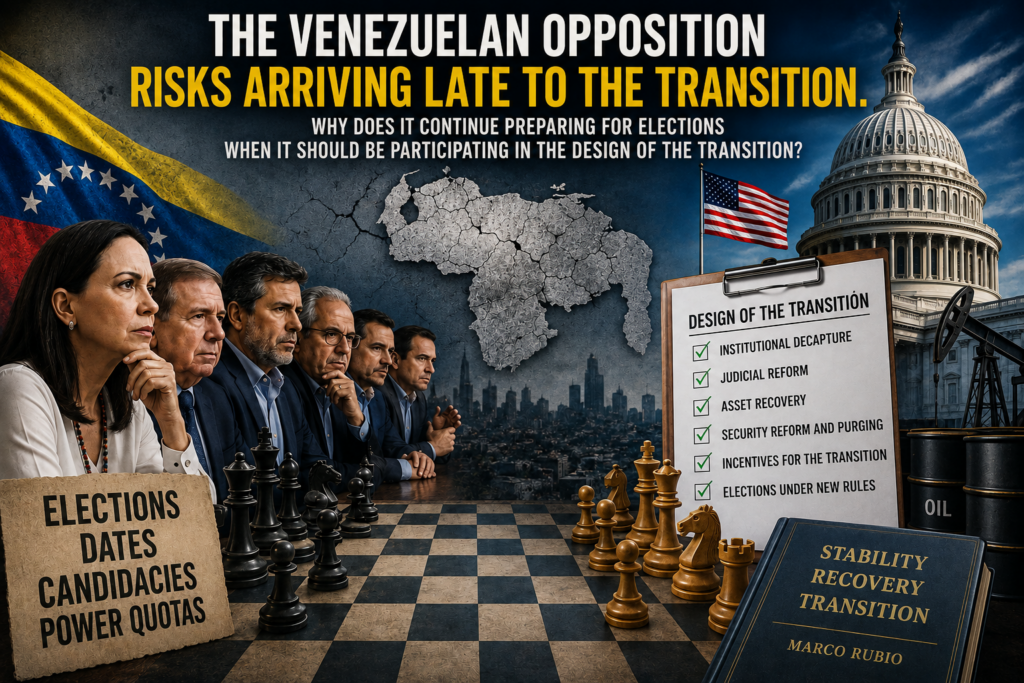
The Venezuelan opposition faces a historical paradox: after years of struggle, persecution, exile, and resistance, it may ultimately arrive late to the most important moment in Venezuela’s political process. Not because it lacks legitimacy. Not because it lacks popular support. Not because it has failed to demonstrate its capacity for mobilization.
The risk is another: that it continues preparing to compete in elections while others design the real architecture of the transition.
The decisive question is no longer simply when elections will take place. The question is who is designing the rules, incentives, institutions, and guarantees under which Venezuela could emerge from a Captured State.
And this is where the central problem emerges: a large part of the opposition continues to act as if Venezuela were facing a classic democratic transition, when in reality it is confronting a different phenomenon that I have defined and developed as a Captured State Transition (CST). This theoretical framework is based on a fundamental premise: Venezuela is not merely facing the challenge of replacing a government or holding competitive elections, but rather dismantling a power structure in which political, institutional, judicial, economic, and coercive control have become integrated into a single architecture of self-preservation.
Building upon this approach, I have also developed the concept of institutional decapture as a necessary condition for a sustainable transition, as well as the Strategic Transformation of Exit Incentives (STEI), a mechanism designed to alter the cost-benefit calculations of the various actors who sustain the system, facilitating internal fractures, institutional cooperation, and more stable and less traumatic transition processes.
From this perspective, the discussion can no longer be limited to elections, candidacies, or traditional political agreements. The central issue becomes how to rebuild the institutions of the State and how to transform the incentives that have enabled the system’s persistence and reproduction for more than two decades.
María Corina Machado has maintained a line of electoral legitimacy, political return, and the demand for free elections. Edmundo González represents the unrecognized electoral mandate of 2024. Leopoldo López continues insisting on the expectation of elections after years of democratic struggle. Juan Pablo Guanipa maintains that Venezuela is moving toward elections. Henrique Capriles, with greater caution, warns that it is still not possible to speak of a real transition. Antonio Ledezma maintains a position of international pressure and denounces the continuity of Chavismo. And Marco Rubio has proposed a roadmap of stabilization, recovery, and transition.
Each of these elements has value. But none of them, by itself, resolves the core of the Venezuelan problem. Venezuela does not need elections alone.
It needs institutional decapture.
The Error: Confusing an Electoral Exit with a Real Transition
The opposition debate remains trapped in an electoral logic: who will be the candidate, when elections will be held, who will return to the country, who represents legitimacy, and who may occupy positions in an eventual transition. But an election can change authorities without transforming the system. That is the Venezuelan risk.
After more than two decades, power is not sustained solely through ideology or electoral control. It is sustained through an architecture composed of four pillars: institutional control, access to rents, judicial protection, and coercive control. In a classic authoritarian regime, the regime controls the State. In Venezuela, the regime became integrated into the State.
For that reason, the fall of a leader, the partial release of political prisoners, or the promise of elections does not automatically amount to a democratic transition. The real transition begins when the mechanisms that make it rational to remain within the system are dismantled.
What Each Actor Is Proposing
María Corina Machado proposes democratic legitimacy, free elections, political return, and the defense of the popular mandate. Her strength is moral and electoral clarity. Her strategic weakness is that her public discourse remains focused on democratic competition rather than on the institutional engineering of decapture.
Edmundo González represents the continuity of the 2024 electoral mandate. His role is fundamental as a symbol of democratic legitimacy. But the electoral mandate must be transformed into a governing architecture, judicial reform, asset recovery, and reconstruction of the State apparatus.
Julio Borges and Tomás Guanipa, through Primero Justicia and their spheres of influence, represent sectors that have historically relied on negotiation, international pressure, and an electoral exit. The problem is that an electoral strategy without prior institutional reform may end up legitimizing an incomplete transition.
Marco Rubio has proposed a sequence of stabilization, recovery, and transition. It is a politically communicable and strategically understandable roadmap. But its risk is evident: if Venezuela is stabilized without decapturing the State, stabilization may end up financing the continuity of the captured structure.
What They Are Doing
The opposition is seeking to reposition itself. Some are seeking to return. Others are seeking to influence. Others are seeking recognition. Some are preparing for elections. Others are attempting to recover internal political space.
None of that is illegitimate.
The problem is that the historical moment demands something more. The opposition should be producing a formal proposal for a structural transition to present to Marco Rubio, Donald Trump, the U.S. Department of State, the U.S. Congress, the OAS, the European Union, and the leading think tanks in Washington.
It should be discussing how to reform the Judiciary. It should be proposing an independent truth and investigative commission. It should be designing mechanisms for international asset recovery. It should be proposing how to purge security institutions without destroying the State. It should be proposing differentiated incentives to fracture the internal cohesion of the ruling bloc. It should be bringing a clear thesis to Washington: without institutional decapture, there will be no real transition.
What They Are Omitting
The great omission of the Venezuelan opposition is that it has not made the decapture of the State the central focus of its agenda.
It speaks about elections. It speaks about legitimacy. It speaks about political prisoners. It speaks about return. It speaks about recognition. It speaks about unity.
But it does not speak with sufficient precision about the mechanisms that would make it possible to transform the State.
The opposition must answer questions that remain unresolved today:
How will the Supreme Tribunal of Justice be reformed? How will the Public Prosecutor’s Office be rebuilt? How will the intelligence services be restructured? How will cooperating officials be protected without granting generalized impunity? How will stolen assets be recovered? How will distinctions be made between those responsible for serious crimes, administrative operators, and cooperative actors? How will a new elite be prevented from capturing institutions under a democratic appearance? How will the transition avoid becoming merely a change of faces?
These are the questions that should be on the table.
Not after the elections.
Before them.
Washington Is Now the Strategic Battlefield
The Venezuelan opposition continues to act as if the principal battle were taking place exclusively in Caracas. But a decisive part of Venezuela’s future is being defined in Washington.
That is where sanctions are debated. That is where oil is debated. That is where investment is debated. That is where diplomatic normalization is debated. That is where regional security is debated. That is where migration is debated. That is where judicial cooperation is debated. That is where the type of transition the United States is willing to support is being debated.
If the opposition does not bring a structured proposal, others will fill that vacuum. And that vacuum may be filled by a dangerous logic: stabilize first, recover later, democratize someday. That sequence may appear prudent. But in a Captured State it can be fatal.
Because stabilizing without decapturing can strengthen the very networks that are supposed to be dismantled.
Decapture Is Also Good Business for the United States
There is an additional reason why the Venezuelan opposition should be actively promoting an institutional decapture agenda in Washington: even from a strictly pragmatic, economic, and geopolitical perspective, a decaptured Venezuela benefits the United States more than a merely stabilized Venezuela.
If the American objective were simply to gain access to larger volumes of oil, gas, strategic minerals, and investment opportunities, decapture would still be the better option. Captured economies generate legal uncertainty, corruption, regulatory arbitrariness, and elevated contractual risks. Companies can invest, but they invest less. They can produce, but they produce below their potential. They can earn profits, but they demand risk premiums that make every project more expensive.
A Venezuela in which judicial, administrative, and patrimonial capture mechanisms remain intact will continue to be a high-risk market. Contracts will remain exposed to future disputes, investors will demand higher returns to compensate for uncertainty, and capital flows will be lower than those that could be attracted by a country with credible institutions.
By contrast, a Venezuela that advances judicial reform, institutional transparency, asset recovery, and State reconstruction would offer far more attractive conditions for American investment. The result would be greater oil production, greater gas development, more private investment, stronger economic growth, and a far more stable and profitable relationship for both sides.
In other words, institutional decapture is not merely a Venezuelan democratic demand. It is also an economically rational decision for the United States. A merely stabilized Venezuela can generate business opportunities. A decaptured Venezuela can generate far more value, far more investment, and far more wealth.
For that reason, the strategic question for Washington should not be limited to how to stabilize Venezuela. It should be how to rebuild Venezuelan institutions in order to maximize stability, investment, and the country’s economic potential over the coming decades.
This argument has an important advantage: it does not ask the United States to act out of altruism or democratic idealism. It argues that decapture aligns with American economic, energy, and geopolitical interests, making it a far more persuasive case for policymakers and strategic decision-makers.
The Proposal That Should Be Taken to Rubio and Trump
The Venezuelan opposition should present Washington with a concrete agenda based on six points:
- Creation of an independent truth and investigative commission, with international support.
- Verifiable judicial reform, including vetting mechanisms and the redesign of appointment procedures.
- Reconfiguration of the coercive apparatus, particularly intelligence agencies, police forces, and politicized chains of command.
- International cooperation for the tracing, freezing, and recovery of assets.
- Strategic Transformation of Exit Incentives (STEI), combining differentiated guarantees for cooperative actors with targeted pressure on irreducible sectors.
- Elections under a new institutional architecture, not as the starting point but as the culmination of a real transition.
This agenda does not contradict Rubio’s proposal.
It strengthens it.
Stabilization is necessary. Economic recovery is necessary. Elections are necessary. But none of these three phases, by themselves, guarantees the reconstruction of the State.
The Danger of Preserving Too Much
The United States learned from Iraq, Libya, and Syria that destroying institutions can produce chaos. That lesson is correct. But Venezuela presents the opposite problem. Here, the risk is not destroying too much. The risk is preserving too much.
Preserving intact the judicial, coercive, and patrimonial mechanisms of the old system may produce an apparent transition, but not a real transformation. The result would be a superficial democracy: new authorities, old structures, new elections, and the same incentives.
That would not be a transition.
It would be a rearrangement.
The Historical Responsibility of the Opposition
The Venezuelan opposition has the right to prepare for elections. But it also has the historical responsibility to prepare to govern a State that will have to be rebuilt from its institutional foundations. And governing does not simply mean occupying positions of power.
Governing means designing institutions.
The opposition cannot limit itself to waiting for Washington to define the transition.
It must influence that definition. It must produce serious proposals. It must take them to Congress. It must present them to the Department of State. It must discuss them with Rubio. It must bring them to Trump.
It must explain that Venezuela is not facing merely a dictatorship, but a Captured State. And it must warn that without institutional decapture, any transition can fail even after successful elections.
Conclusion
The Venezuelan opposition risks committing a historic mistake: preparing to win elections without participating in the design of the transition. The country does not need merely an electoral roadmap. It needs an institutional reconstruction architecture.
The central question is not only when Venezuelans will vote. The central question is under what kind of State they will vote.
A State that remains captured?
Or a State undergoing a real process of decapture?
That difference will define Venezuela’s future.
The transition will not begin on the day an election is announced. It will begin on the day a serious strategy exists to dismantle the mechanisms that captured the Venezuelan State.
And if the opposition does not lead that discussion, others will design the transition for it.
Emir Moros Adams. May 29th 2026