
Introduction: Sequence Matters, but Diagnosis Matters More
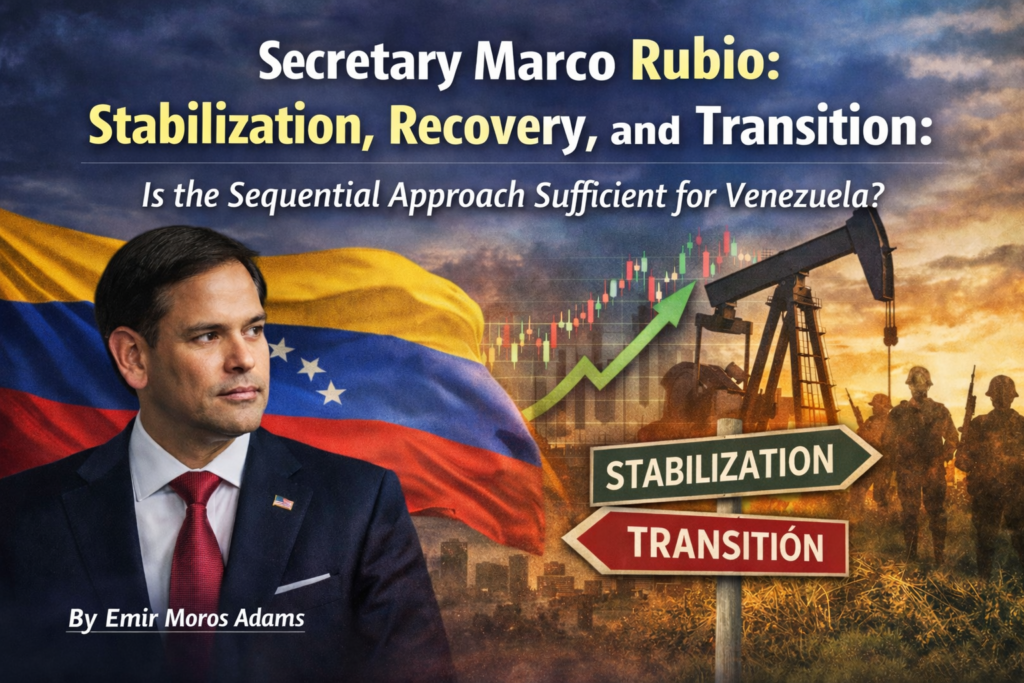
In the debate over Venezuela’s future, Secretary Marco Rubio has proposed a three-stage roadmap: stabilization, recovery, and transition.
At first glance, the framework appears reasonable. First, chaos is reduced. Then, the economy is rebuilt. Finally, the path is opened toward political transition.
The problem is not the order. The problem is the diagnosis.
If Venezuela were a classic authoritarian regime, that sequence might be sufficient. But if what we are confronting is a structurally captured State—a concept I created and developed in my articles Venezuela After the Shock and Beyond Democratic Transition—then stabilizing without de-capturing may ultimately consolidate what is intended to be dismantled. Stabilization is not the problem. The problem is its sequencing in relation to institutional reform.
Two Distinct Conceptual Frameworks
The Political-Sequential Approach
The sequence publicly proposed by Secretary Rubio may be summarized as follows:
- Stabilization
Reduction of internal and external tensions.
Humanitarian relief.
Progressive normalization. - Economic Recovery
Energy reactivation.
Financial reintegration.
Investment flows. - Political Transition
Institutional opening.
Elections.
Democratic reconstruction.
It is a linear logic. Ordered. Communicable and politically presentable.
The Captured State Transition (TEC) Framework
The TEC is grounded in a different premise. The Venezuelan problem is not merely political nor merely economic. It is structural. In a captured State:
- Power is not only political control.
- It is access to formal and informal rents.
- It is penal shielding.
- It is coercive control.
- It is institutional self-protection.
For that reason, the sequence cannot begin with the economy. It must begin with the architecture of power. The TEC proposes:
- Independent investigation
- Judicial reform and vetting
- Reconfiguration of the coercive apparatus
- International cooperation on assets
- Strategic Transformation of Exit Incentives (TEIS)
- Elections under a new institutional architecture
Here, elections do not inaugurate the transition. They consolidate it. That sequential difference reflects distinct diagnoses. The sequence proposed by Rubio implicitly rests on a diagnosis according to which the Venezuelan crisis is primarily a combination of institutional collapse, economic deterioration, and political fragmentation that requires the reduction of immediate risks before any profound transformation. Under that logic, stabilizing means containing the humanitarian emergency, reducing geopolitical tensions, restoring minimum levels of governability, and creating macroeconomic conditions that prevent a new collapse. That approach is not irrational; it is consistent with multiple transition processes in which the State, though weakened, retains minimal functional autonomy. However, the critical point is that in Venezuela the state structure is not merely eroded, but integrated into an architecture of capture. If the diagnosis underestimates that structural component, the sequence may organize the process, but it will not alter the balance of power that sustains it.
Structural Comparison
In the following table, I compare the sequence proposed by Rubio with the TEC framework. Although the former is politically presentable and orderly, its logic may prove insufficient in a captured State, where economic measures do not substitute for institutional de-capture.
| Dimension | Rubio Approach | TEC Approach |
| Implicit Diagnosis | Political and institutional crisis requiring the reduction of immediate risks through stabilization | Systemic capture: power = institutions + rents + shielding |
| Initial Priority | Stabilization and macro-governability | Minimal institutional autonomy (justice/security) |
| Role of Justice | Secondary or subsequent | Precondition: judicial reform + vetting |
| Incentives of the Dominant Bloc | Not central to the design | Core element: TEIS to fracture defensive cohesion |
| Elections | Political culmination of the process | Result of de-capture (not the starting point) |
| Primary Risk | Incomplete transition due to state weakness | Normalization without de-capture (adaptive capture) |
The difference is not academic. It is strategic.
The Risk of Premature Stabilization
In a context of structural capture, external stabilization may:
- Reactivate revenue flows.
- Reduce international pressure.
- Strengthen the cohesion of the dominant bloc.
- Decrease incentives for internal fracture.
This is what I refer to as the risk of normalization without de-capture. Transactional stability (energy, migration, regional security) can coexist with an intact institutional architecture. And when that architecture remains intact, the strategic rationality of the elite does not change. The reactivation of energy flows increases the distributive capacity of the dominant bloc; the reduction of international pressure decreases incentives for internal cooperation; diplomatic normalization expands room for maneuver without altering the judicial architecture. Taken together, these factors may reinforce defensive cohesion rather than fracture it.
The Missing Element: Incentives
In a captured State, actors do not remain solely for ideological reasons. They remain because:
- Exiting implies penal risk.
- Exiting implies patrimonial loss.
- Exiting implies personal vulnerability.
- Exiting implies the rupture of protection networks.
For that reason, transition requires a Strategic Transformation of Exit Incentives (TEIS).
Without differentiation:
- If all are punished → cohesion is reinforced.
- If all are protected → there is no incentive to defect.
- If some receive credible guarantees and others face credible risk → fracture emerges.
Real transition begins when the internal calculus of power changes.
¿Are Both Approaches Compatible?
Yes, but only under one condition: that the stabilization phase explicitly include:
- An independent commission with real protection.
- Verifiable reform of the judicial system.
- Reconfiguration of chains of command within the security sector.
- International cooperation in asset recovery.
- Strategic segmentation of incentives.
Without these elements, economic recovery may finance the continuity of the system.
And this point is not merely internal to Venezuela. It has direct implications for the United States. For the United States, the difference is not theoretical but operational. A strategy focused exclusively on stabilization and recovery may reduce regional risks in the short term—migration, energy, security—but not necessarily transform the internal incentives of the dominant bloc. If external normalization precedes judicial reform and the strategic segmentation of incentives, the result may be a transactional stabilization that preserves the architecture of capture under new conditions. By contrast, if U.S. policy links any process of relief or reintegration to verifiable milestones of institutional autonomy and incentive reconfiguration, stabilization can become a lever for transformation. The strategic question for Washington is not whether to stabilize, but how to do so without consolidating the equilibrium that is intended to be changed.
What Is at Stake?
If the priority is:
Stabilization → Recovery → Elections
without prior institutional de-capture, the probable scenario is:
- Superficial alternation.
- Fragile delegative democracy.
- Re-capture under new elites.
- Structural continuity with a change of face.
But if the priority is:
Investigation → Judicial Reform → TEIS → Elections
The transition may become a sustainable rupture.
The Central Question
The question is not whether Venezuela needs stabilization. It does. The question is:
Stabilize what?
An intact structure?
Or a system in the process of reconstruction?
The difference defines the type of country that will emerge.
Conclusion
The sequence “stabilization, recovery, and transition” is politically attractive. But in a captured State, it may be insufficient. The Venezuelan experience shows that the removal of a leader does not equate to structural transformation. Real transition does not begin with elections. It begins when the institutional design that makes remaining within the system rational is changed.
Without de-capture, democracy risks becoming procedure without transformation. With de-capture, it can become sustainable institutional order. The difference between stabilization and transformation is not semantic. It is structural. The former administers the existing equilibrium. The latter redefines it.