
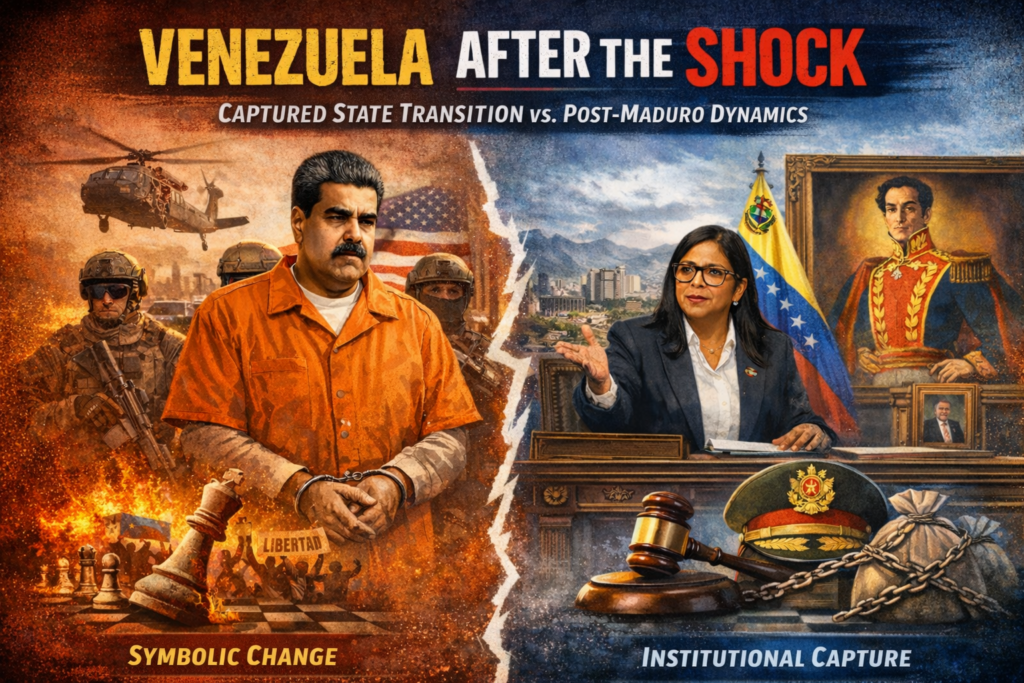
Introduction: Disruptive Event vs. Structural Transformation
The detention and extraction of Nicolás Maduro on January 3, 2026 constituted a disruptive event of high geopolitical impact. In classical transition theory, the abrupt removal of the head of the Executive is usually interpreted as a regime breaking point. However, the category of Captured State Transition (CST) proposes a fundamental distinction: the fall of a leader does not necessarily equate to the transformation of the institutional architecture that sustains power. The central analytical question is not whether a substitution occurred at the apex of power, but whether the structural incentives that maintain the cohesion of a dominant coalition within a captured state were altered. This article contrasts the sequential model proposed in the CST with the observable developments in Venezuela during the weeks following January 3, 2026.
The CST Framework: Transition as Institutional De-Capture
The CST begins from a structural distinction:
- In a classic authoritarianism, the regime controls the State.
- In a captured state, the dominant coalition is structurally integrated into the State.
In the second case, power is not only political. It is also:
- Penal shielding
- Patrimonial protection
- Access to formal and informal rents
- Coercive control
Therefore, exit from power entails existential costs. The sequence proposed by the CST is clear:
- Independent investigation
- Judicial reform and vetting
- Reconfiguration of the coercive apparatus
- International cooperation on assets
- Differentiated guarantees (Strategic Transformation of Exit Incentives – STEI)
- Elections under new institutional conditions
The logic is structural: without prior de-capture, electoral competition tends to reproduce the dominant architecture.
Post–January 3, 2026 Observed Dynamics
- Removal of the Apex of Power
Maduro’s detention altered the symbolic apex of the regime. However, the internal structure of the governing coalition (formal/structural apex) demonstrated a capacity for rapid reorganization. From the CST perspective, this may be interpreted as substitution of the apex (the central face of the regime) without verifiable modification of the institutional architecture. The key question is whether a structural rupture occurred or a reorganized continuity.
- Humanitarian Amnesty and Release of Political Prisoners
The approval of an amnesty and the release of political detainees constitute a relevant humanitarian advance. These measures reduce international pressure and alleviate internal tensions. Nevertheless, analytically a distinction must be made:
Amnesty for victims of repression ≠ structural recalibration of the dominant bloc’s incentives.
The release of political prisoners does not necessarily alter:
- Judicial autonomy
- The structure of the Public Prosecutor’s Office
- Coercive chains of command
- Institutional self-protection mechanisms
From the CST perspective, these measures may contribute to external stabilization without producing internal de-capture.
- Continuity of the Structural Pillars
To date, there are no publicly observable clear signals of:
- The creation of an independent investigative commission with real institutional protection.
- A structural redesign of the judicial appointment system.
- Deep reform of the security sector.
- A comprehensive program of international cooperation for asset tracing and recovery.
In the absence of these elements, the pillars of defensive cohesion remain relatively intact.
Comparative Matrix: CST Model vs. Observed Dynamics
| CST Stage | Structural Indicator | Observable Evidence | Structural Assessment |
| Independent investigation | Autonomous commission with verifiable mandate | Not visibly robust | No segmentation of responsibilities |
| Judicial reform | Redesign of appointments and autonomous prosecutor’s office | No clear structural reform | Persistence of shielding mechanisms |
| Security sector reform | Reconfiguration of chains of command | No evidence of systemic transformation | Coercive capacity intact |
| Asset cooperation | Coordinated tracing and freezing | Not a visible central axis | Rents not structurally altered |
| Differentiated guarantees (STEI) | Calibrated segmentation | Partial humanitarian amnesty | Political gesture, not structural recalibration |
| Elections under new architecture | Minimum institutional autonomy | Not yet verified | Risk of reproduction |
Emerging Pattern: Stabilization Rather Than Transformation
The observable sequence appears to respond to a different pattern than that proposed by the CST:
- Disruptive event
- Immediate political reorganization Humanitarian and relief gestures
- Humanitarian and relief gestures
- Search for stabilization and normalization
In contrast, the CST model proposes:
Structural diagnosis → segmentation → judicial reform → coercive reform → recalibration of incentives → electoral consolidation.
The difference is not minor: it affects the probability of a sustainable rupture.
Risk of Incomplete Transition
In contexts of systemic capture, the primary risk is not the immediate restoration of the previous leadership, but the preservation of the architecture of capture under new conditions. Three structural risks can be identified:
- External normalization without internal de-capture
The reduction of international pressure may decrease incentives for structural negotiation.
- Elections without institutional autonomy
Electoral competition in the absence of judicial and coercive reform may generate superficial alternation.
- Preserved defensive cohesion
Without Strategic Transformation of Exit Incentives, the dominant coalition retains incentives to remain united.
Indicators of Alignment with the CST
From a strictly analytical perspective, the transition would begin to align with the CST if the following were observed:
- An independent commission with real guarantees.
- Verifiable reform of the judicial system.
- Structural reconfiguration of the coercive apparatus.
- Active international cooperation regarding assets.
- Explicit and calibrated segmentation of incentives.
Without these signals, the process remains in a phase of political stabilization, not institutional reconstruction.
Structural Conclusion
The Venezuelan case post–January 3 confirms the central premise of the Captured State Transition:
The removal of a leader is a necessary, but not sufficient, condition for democratization under conditions of systemic capture. What has been observed thus far suggests a phase of stabilization and humanitarian adjustment, but no conclusive public evidence of deep institutional de-capture.
In captured states, the difference between transition and re-accommodation lies in whether the architecture of incentives that sustains the defensive cohesion of the power bloc is altered. The decisive variable is not who occupies the office. It is whether the structural design that makes remaining within the system rational has changed.
By Emir Moros Adams
February 24 2026