
The first step is to clear the noise: negotiating with Delcy Rodríguez does not mean “legitimizing” her. It means recognizing—through facts on the ground—who retained operational command capacity after a disruptive event of extraordinary magnitude: the capture of Nicolás Maduro by U.S. forces and his transfer to the U.S. judicial system.
In political science, when a regime enters a phase of reconfiguration, the relevant question is not “Who would I like to talk to?” but rather “Who can actually implement what is agreed?” That is where Delcy Rodríguez emerges—not as an ideal choice, but as the operable option within a menu of suboptimal alternatives.
1) The Shock That Reorders the Board: From Personalist Hegemony to Factional Equilibrium
Maduro’s capture did not merely remove an individual; it altered the regime’s internal coordination mechanism. Under the Venezuelan Constitution, even though a formal declaration of absolute absence and specific procedures are required, Delcy Rodríguez effectively becomes acting/interim president in Maduro’s absence, with the implicit backing of a judiciary aligned with the regime.
This matters because it introduces an element of formal institutional continuity (however contestable in democratic terms), which facilitates what Washington typically seeks in complex transitions: a hinge actor.
Before and After: How the Power Architecture Changes
Analytically, the key is not the exact number of actors but the concept: the regime ceases to function as a personalist authoritarian presidency and shifts toward a coalitional authoritarianism, where authority results from pacts, mutual surveillance, and rent distribution.
Such regimes do not collapse due to “moral illegitimacy” (which they undeniably possess), but rather through coalition fracture.
2) Washington’s Criterion: Not Ethics, but “Capacity for Compliance” (Under Coercion)
For the United States, the immediate objective does not appear to be “reinventing Venezuela overnight,” but rather managing the day after Maduro’s capture: stabilizing the situation, containing spillovers, securing strategic interests (migration, security, transnational crime, energy), and opening a channel that makes an orderly transition feasible.
The moment can be described as one of maximum political tension, with Delcy simultaneously seeking a cooperation agenda while publicly condemning the operation.
This fits the classic logic of asymmetric negotiation:
- The U.S. negotiates from material power and credible coercion, demonstrated by the fait accompli of Maduro’s capture.
- Delcy negotiates from regime survival, compounded by internal distrust: if “Maduro fell,” anyone could be next.
This type of negotiation does not seek friendship; it seeks behavioral control.
3) Why Delcy (and Not Padrino or Cabello): The Filter of “Reliability + Operability”
The hypothesis regarding Trump’s distrust of Vladimir Padrino López and the sidelining of Diosdado Cabello aligns with a well-known foreign policy criterion: preference for an interlocutor with institutional capacity and a lower probability of immediate sabotage, even if that interlocutor is politically toxic.
- Padrino López: indispensable for military control, but if perceived as a double-game actor, his value diminishes. Moreover, the high command may prefer to accommodate the new equilibrium rather than expose itself.
- Cabello: raises reputational costs, increases radicalization risk, and complicates the international “sale” of any opening process.
- Delcy/Jorge Rodríguez: concentrate institutional levers (executive/legislative), diplomatic interlocution, and control over the civilian apparatus.
After Maduro’s capture, Delcy emerged as the figure expected to take the reins, with contact reportedly occurring with Secretary of State Marco Rubio in that context.
4) The Decisive Variable: Internal Fear and Enforced Discipline
What is most underestimated in these processes is not diplomacy but the psychological–political mechanism activated when a regime realizes that the cost of non-cooperation has risen dramatically.
AP reports that Maduro’s defense may invoke sovereign immunity, while also recalling precedents where such strategies failed (e.g., Noriega). The legal detail matters less for its technical merits than for its political signal: the leadership shield no longer protects.
The result is a new form of internal discipline—driven by fear, not conviction.
Possible Scenarios: What Comes Next (and How to Read the Signals)
Authoritarian transitions are not linear; they are games of signals, loyalties, and costs.
Scenario Matrix: Triggers and Early Indicators
| Scenario | What It Looks Like | Conditions | Early Signals |
| A) Pacted and controlled transition | Gradual opening, conditional electoral timeline | Delcy sustains coalition; U.S. offers calibrated relief | Verifiable gestures (prisoners, habilitations, CNE, observation); sustained U.S.–Caracas communication |
| B) Continuism with a “new face” | Cosmetic change, no systemic reform | Coalition closes ranks out of fear | Conciliatory rhetoric + selective repression; administrative reforms without real competition |
| C) Militarization of the interim | Armed forces tutor/condition Delcy | FANB demands guarantees, controls tempo | Constant high-command presence; “institutional” communiqués; street control |
| D) Factional war | Cabello–Padrino–Rodríguez clash | Divergent incentives; extreme distrust | Purges, internal arrests, abrupt command changes, leaks |
| E) Governability crisis | Protests, paralysis, social conflict | Economic/service collapse; no credible authority | Protest spikes, regional fractures, accelerated migration |
| F) Internationalization of the conflict | Multilateral pressure or escalation | External reactions, sanctions, energy disputes | OAS/UN moves; Russia/Iran/China positioning; “intervention” narrative |
Three Master Variables That Will Determine the Outcome
- A) Effective control of the coercive apparatus (FANB + intelligence)
Without coercive control, there is no transition—only a fragile interim. If Delcy retains military backing, she can manage an opening; if not, she becomes a hostage.
- B) Incentives: sanctions, justice, and guarantees
Delcy can offer steps (electoral, humanitarian) only if her coalition perceives cooperation as less costly than resistance. The U.S., in turn, will calibrate relief without relinquishing leverage.
- C) Opposition unity and capacity to capitalize
Pacted transitions often collapse if the opposition behaves as a sum of vetoes rather than a governing alternative. A “controlled opening” requires an organized counterpart—or it becomes mere window dressing.
Reasoned Forecast: The Most Likely—and the Most Dangerous—Path
Based on publicly available information:
- Short term: the most likely scenario is managed continuism, with Delcy consolidating internal control while the U.S. demands minimal “deliverables.”
- Greatest risk: factional war, where politics becomes “security” and security becomes “purge.”
- Virtuous scenario: a genuine pacted transition exists, but it requires something rare in authoritarian coalitions—minimum trust and credible guarantees, internal and external.
Closing: What You Saw Was Not the End, but a Change in the Rules
Maduro’s capture does not automatically democratize Venezuela. What it does decisively accomplish is breaking the myth of invulnerability. And in politics, when the myth falls, behavior changes.
Actors Map and Decision Tree
Strategic Reading of Venezuela’s Power Reordering (January 2026)
What follows is an actors map—interests, capacities, vulnerabilities—and a decision tree to anticipate trajectories, breaking points, and early signals. The approach is analytical, not normative.
- Actors Map: Who Decides, Who Can Block
- Internal decision core (hard power and institutional power)
| Actor | Current Role | Primary Interest | Real Capacity | Vulnerabilities |
| Delcy Rodríguez | Civil–institutional hinge | Regime survival + process control | High | External pressure; internal distrust |
| Jorge Rodríguez | Political architect / Plan B | Legislative control, succession | High | Reputational cost; rivalries |
| Vladimir Padrino López | Military guarantor | FANB cohesion | Very high | Eroded credibility; sanctions |
| Diosdado Cabello | Hard-line party pole | Rents and territorial control | Medium–high | External isolation; internal friction |
Key reading: Delcy/Jorge decide; Padrino can veto; Cabello can sabotage.
- External actors (coercive power and incentives)
| Actor | Interest | Tools | Tolerance Threshold |
| Donald Trump | Stability + risk control | Judicial coercion, sanctions, recognition | Low |
| Marco Rubio | Conditional transition | Diplomacy, calibrated relief | Low–medium |
| OAS / UN | Stability, mediation | Discreet channels | High |
- Latent actors (destabilization capacity)
| Actor | Capacity | Risk |
| Fragmented opposition | Low–medium | Missed political window |
| Civil society / street | Variable | Escalation if no signals |
| Illicit economic networks | Medium | Silent sabotage |
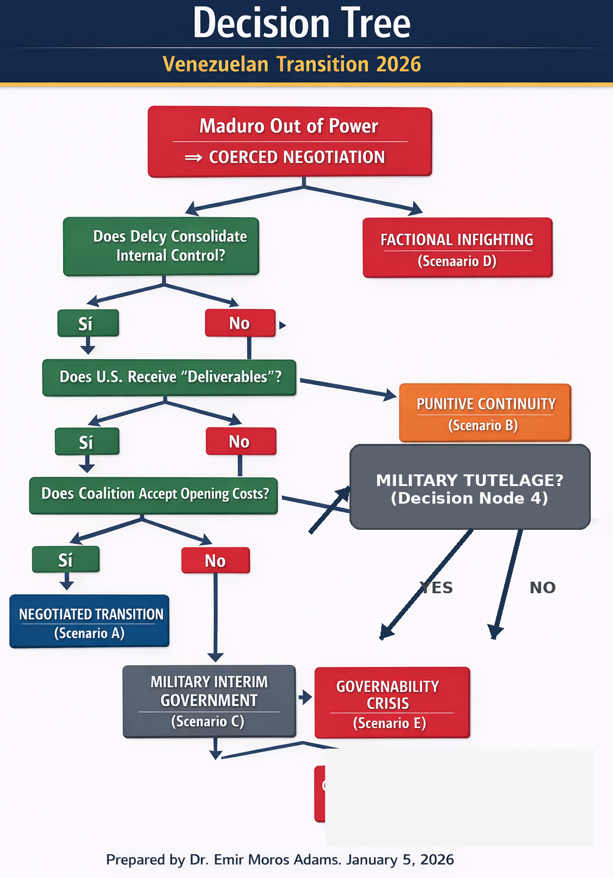
- Decision Tree: Paths, Bifurcations, Consequences
Node 0 — Structural event
Maduro removed ⇒ negotiation under credible coercion.
Node 1 — Does Delcy consolidate internal control?
Yes ⇒ Node 2
No ⇒ Factional war (Scenario D)
Indicators (7–14 days): FANB communiqués, PSUV discipline, absence of visible purges.
Node 2 — Does the U.S. receive verifiable “deliverables”?
Yes ⇒ Node 3
No ⇒ Punitive continuism (Scenario B)
Indicators: independently verifiable announcements; conditional partial relief.
Node 3 — Does the coalition accept the costs of opening?
Yes ⇒ Pacted transition (Scenario A)
No ⇒ Node 4
Node 4 — Internal tutelary military intervention (FANB)?
Yes ⇒ Militarization of the interim (Scenario C)
No ⇒ Governability crisis (Scenario E)
III. Final Scenarios (Qualitative Probability)
| Scenario | Description | Probability | Risk |
| A | Pacted transition | Medium | Medium |
| B | “Light” continuism | Medium–high | Medium |
| C | Militarization | Medium | High |
| D | Factional war | Medium | Very high |
| E | Governability crisis | Low–medium | High |
- Early Signals That Kill Scenarios
- A collapses without independent verification.
- B collapses if the U.S. withdraws relief and raises costs.
- C collapses if the FANB fractures.
- D only collapses with effective external mediation.
- E collapses if emergency economic agreements emerge.
- Operational Conclusion
The system has entered negotiation under credible threat. Delcy/Jorge administer, Padrino conditions, Cabello lurks. Washington demands. The outcome will hinge on verifiable deliverables and whether the coalition internalizes that cooperation is less costly than resistance.